MCP governance: what it is and how to do it right
MCP governance is the set of policies and technical controls that decide which Model Context Protocol (MCP) servers an organization's AI agents can connect to, who approves them, what those agents are allowed to do, and what gets recorded when they act. In short, it is the control plane that keeps agentic AI fast without letting it become an ungoverned execution surface inside your infrastructure.
Every MCP server an agent connects to can make API calls, query databases, read files, or trigger automation. That makes MCP governance closer to managing privileged access than managing a normal integration. As one common framing puts it: if an AI agent can execute actions, it deserves governance equal to a human with admin rights.
This guide explains what MCP governance covers, the risks that make it necessary, the frameworks worth aligning to, and a practical set of best practices you can apply today.
Why MCP governance matters now
The Model Context Protocol has quickly become the default way to connect AI agents to tools, databases, and SaaS systems. Adoption has outpaced control. Most enterprises cannot say how many MCP servers are running across their teams, which is itself the signal of a governance gap already in production.
The problem compounds because MCP servers are active components, not passive data consumers. Four dynamics make ungoverned MCP genuinely risky:
- Credential sprawl. Every MCP connection creates a new secret: an API key, OAuth token, database string, or service-account credential. A team running ten agents with five connections each is already managing fifty-plus credentials, each with its own owner, rotation requirement, and place to leak.
- Shadow MCP. Developers and citizen developers wire agents to GitHub, Slack, internal databases, and third-party APIs without security review, creating shadow servers no one has vetted.
- A new, executable attack surface. Because agents act on interpreted intent rather than hard-coded commands, a single poisoned tool or crafted prompt can turn legitimate access into a breach.
- Agents are autonomous systems. They can act on their own. If they have the means to send an email or delete a CRM record, at some point they will do it unsolicited.
Why traditional API security is not enough
It is tempting to treat MCP like any other API and point existing tools at it. That fails because the interaction model is fundamentally different.
| Aspect | Traditional API security | MCP governance |
|---|---|---|
| Interaction model | Command-based: a client makes explicit, predefined calls | Intent-based: an agent interprets a goal and decides which tools to call |
| Request predictability | High and coded by developers | Low; agents generate novel sequences and parameters |
| Client intent | Assumed benign and deterministic | Must be assumed potentially misled (e.g., by prompt injection) |
| Primary focus | AuthN, AuthZ, known web exploits | Agent identity, scope minimization, prompt injection, tool call authorization |
A firewall or web application firewall can validate an IP and port, but it cannot read an MCP payload to catch a poisoned tool description or check whether an agent's token actually carries the right scope. MCP governance has to operate at the application layer, where the agent's identity, intent, and permissions are visible.
The core risks unique to MCP
A defensible governance program starts from the threats it has to contain. The most important MCP-specific risks, several of which now appear in the OWASP MCP Top 10, are:
- Tool poisoning. First documented by Invariant Labs in April 2025, this attack embeds malicious instructions inside a tool's description or schema that the model reads as trusted configuration. A large-scale study of 1,899 open-source MCP servers found 5.5% affected.
- Prompt injection. Crafted inputs hijack an agent's reasoning, pushing it to call tools it should not or to exfiltrate sensitive context to an external server.
- Confused deputy and SSRF. An agent with legitimate internal access is tricked into acting on an attacker's behalf, for example reaching internal systems it was never meant to touch.
- Non-human identity sprawl. Each agent and connection is a new non-human identity with its own credentials and permissions, expanding the attack surface far faster than human identity ever did.
- Credential exposure. MCP config files, CI/CD pipelines, and even Slack or Confluence become leak points where live secrets get committed or pasted.
A framework for MCP governance
The most durable way to organize MCP governance is to map controls to a recognized risk framework rather than inventing one. The NIST AI Risk Management Framework offers four functions, Govern, Map, Measure, and Manage, that translate cleanly into MCP practice. Standards such as ISO/IEC 42001 and the EU AI Act reinforce the same principles. Within that structure, MCP governance rests on five operational pillars.
1. Discover and inventory (Map). You cannot govern what you cannot see. Build a single authoritative catalog of every MCP server, the tools it exposes, the agents that consume it, and who owns each connection. Network analysis, repository scanning, and developer registration all feed this inventory, which is the foundation everything else stands on.
2. Authenticate (Govern). Standardize how agents prove who they are, ideally using the same modern login standards your workforce already relies on. The MCP specification has moved to OAuth 2.1, which means temporary, tightly limited access passes rather than permanent keys. In practice: give each agent short-lived credentials scoped to exactly what it needs, store them in a secure vault, and ban shared or hardcoded passwords outright. A leaked permanent key is one of the easiest ways for an AI integration to turn into a breach.
3. Authorize with least privilege (Manage). Scope each connection to the minimum it needs: one MCP server per trust boundary, separate credentials per environment, and permissions narrowed to specific tables, repos, or endpoints. If an agent is compromised, the attacker inherits exactly the access you granted, so every unnecessary scope is added blast radius.
4. Audit and observe (Measure). Every approval, version change, and tool call should leave an immutable trace in your SIEM, including the server name, version, parameters, and who approved it. When an auditor asks which MCP servers touched production last quarter, the answer should already exist. Track metrics such as un-inventoried servers detected, authorization-failure rates, and time to detect an incident.
5. Govern the lifecycle (Govern). Approval is not a one-time event. Maintain a trusted registry as your allowlist, pin approved versions, re-validate on new releases or advisories, and revoke credentials immediately when an agent or server is decommissioned, then verify the revocation actually propagated.
MCP governance best practices checklist
For teams that want a quick reference, the essential controls are:
- Maintain a central registry of every MCP server, tool, and the agents that use them.
- Require approval and vetting before any third-party or internal server reaches production.
- Use OAuth 2.1 with short-lived, narrowly scoped tokens; ban long-lived shared keys.
- Inject credentials at runtime from a secrets manager; never commit them to config files.
- Enforce least privilege and environment isolation on every connection.
- Sandbox untrusted servers and apply strict egress controls to limit exfiltration.
- Centralize immutable audit logs and alert on authorization failures and anomalies.
- Continuously scan repos, pipelines, and collaboration tools for exposed MCP credentials.
- Review access and prune unused connections on a regular cadence.
The MCP gateway: a central control plane
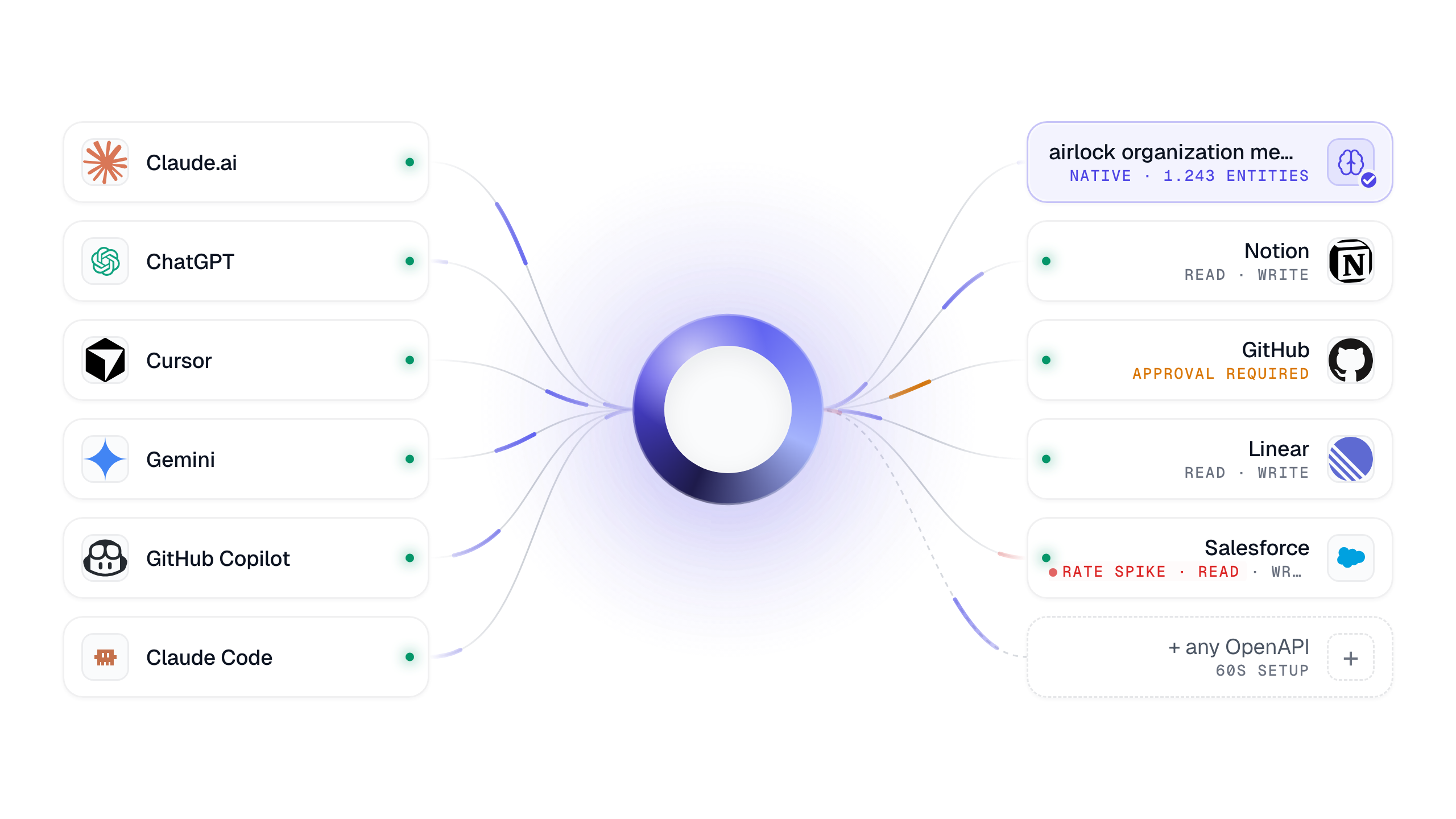
Implementing these controls server by server does not scale and drifts over time. The emerging architectural answer is an MCP gateway: a specialized proxy that sits in front of all MCP servers and acts as a single checkpoint for every agent request. Instead of each team rebuilding authentication, authorization, logging, and policy logic, the gateway centralizes them, the same way API gateways consolidated control in the microservices era.
A capable gateway validates agent identity and OAuth tokens, enforces fine-grained tool-level access, applies rate limits and input validation to blunt prompt injection, and produces the immutable audit trail compliance requires, all from one place. That decoupling lets a platform team enforce policy uniformly without slowing the developers building agents.
How airlock approaches MCP governance
airlock is a unified governance layer that puts the gateway pattern into practice for enterprise AI agents. Rather than asking each team to harden its own connections, it routes agent traffic through a single, policy-aware control point.
In practice that means a unified connector layer over the MCP ecosystem with full tool-level audit logs, so every agent action is visible and attributable. Credentials are vaulted and brokered centrally instead of living in config files, and an enterprise security proxy moves beyond simple allowlisting to inspect traffic, redact PII automatically, and enforce policy in real time. For high-stakes actions, human-in-the-loop approvals and a kill switch let teams pause or contain an autonomous agent the moment behavior looks wrong. It integrates with existing identity providers such as Okta and Azure AD and works across both cloud and local models, so governance does not force a change in tooling.
The goal is the outcome every MCP governance program is after: agents that move fast, with controls strong enough that security and compliance teams can say yes.
Frequently asked questions
What is MCP governance? MCP governance is the combination of policies and technical controls that determine which MCP servers AI agents can use, who approves them, what each connection is permitted to do, and what is logged when agents act. It makes agent-to-tool connections auditable, least-privileged, and secure at scale.
What is the difference between MCP security and MCP governance? MCP security refers to the specific defenses that protect a server or connection, such as authentication, input validation, and encryption. MCP governance is the broader program, the inventory, policies, approval workflows, ownership, and audit, that ensures those security controls are applied consistently across every server and agent in the organization.
Are MCP servers secure by default? No. The protocol defines how agents and tools communicate but leaves authentication, authorization, and secrets management to the implementing organization. An MCP server is only as secure as the credential and scope governance applied to it, which is exactly why explicit governance is necessary.
How should AI agents authenticate to MCP servers? Use OAuth 2.1 with short-lived, scoped tokens for remote SaaS integrations, and vault-issued dynamic credentials or workload identity for internal services. Reserve scoped API keys for cases where nothing better is available, and always inject credentials at runtime rather than hardcoding them.
Which frameworks apply to MCP governance? The NIST AI Risk Management Framework (Govern, Map, Measure, Manage), the OWASP MCP Top 10 and OWASP guidance for agentic applications, ISO/IEC 42001, and the EU AI Act all provide relevant structure. Most organizations extend their existing non-human identity governance to cover MCP credentials rather than starting from scratch.
How do you start an MCP governance program? Begin with discovery: build a complete inventory of your MCP servers, tools, and agents. Then standardize authentication and least-privilege scopes, add audit logging, and route traffic through a central gateway so policies are enforced uniformly. Treat it as an ongoing program, measured and iterated, not a one-time project.
The bottom line
MCP is becoming the connective tissue of enterprise AI, linking models, agents, and the systems that run the business. Without governance, those connections quietly erode security boundaries built over decades. With it, a blend of inventory, least-privilege authentication, audit, lifecycle control, and a central gateway, organizations get the upside of agentic AI while keeping it accountable. The principles you set now, zero trust, least privilege, and full observability, will be the foundation of your entire AI security posture as agents take on more autonomous work.